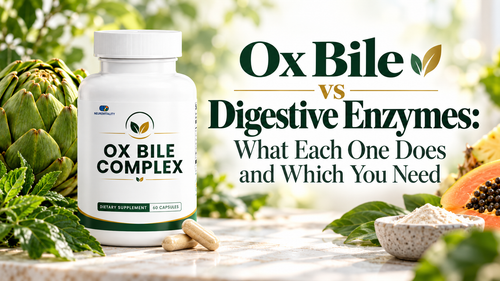
Fat is the hardest macronutrient the body has to break down. Protein and carbohydrates dissolve readily in the watery environment of the digestive tract, but fat does not. It arrives in large globules that enzymes cannot reach. Something has to break those globules apart first, and that something is bile.
Bile rarely gets attention in conversations about digestion. Enzymes and probiotics dominate the discussion. Yet without adequate bile, fat digestion stalls before enzymes ever get a chance to work, and the fat soluble vitamins A, D, E and K travel through the body without being absorbed properly.
Here is how bile works, what ox bile actually is, and why it is often paired with digestive enzymes rather than used on its own.
What Bile Actually Does
Bile is a yellow green fluid produced continuously by the liver. Between meals it collects in the gallbladder, which concentrates it and holds it in reserve. When a meal containing fat reaches the small intestine, the gallbladder contracts and releases that stored bile.
Bile is not an enzyme. It does not chemically cut fat molecules apart. Its job is mechanical, and the technical term for it is emulsification. Bile acids surround large fat droplets and break them into thousands of microscopic ones. This multiplies the available surface area enormously, which matters because the enzyme that digests fat, lipase, can only work on the surface of a droplet.
A useful comparison is washing a greasy pan. Water alone runs straight off. Add dish soap and the grease lifts away, because soap molecules surround the fat and suspend it in water. Bile acids do the same thing inside the small intestine.
Why Fat Soluble Vitamins Depend on It
Vitamins A, D, E and K are fat soluble, meaning they dissolve in fat rather than water. They travel through digestion inside fat droplets and are absorbed alongside them.
This creates a dependency that is easy to overlook. If fat is not being emulsified and absorbed well, those four vitamins are not being absorbed well either, no matter how much of them a diet or supplement provides. Vitamin D is a familiar example. A person can take vitamin D daily and still absorb it inconsistently if fat digestion is not working smoothly, which is one reason vitamin D is usually recommended with a meal containing fat.
What Ox Bile Is
Ox bile is bile sourced from cattle. It is one of the oldest supplemental ingredients still in common use, and it is chemically similar to human bile, containing the same bile acids in comparable proportions.
The meaningful number on any ox bile product is its cholic acid content. Cholic acid is a primary bile acid and the main driver of emulsification, so a product standardized to a stated percentage tells you what you are actually getting. Ox Bile Complex is standardized to 40% cholic acid, which places the active fraction on the label rather than leaving it unstated.
Standardization is worth understanding as a general habit when reading supplement labels. An ingredient listed only by weight tells you how much raw material is present, not how much of the active compound. A standardized extract tells you both.
Bile and Enzymes Do Two Different Jobs
This is the distinction that most often gets blurred, and it explains why the two ingredients are frequently formulated together.
| Bile acids | Digestive enzymes | |
|---|---|---|
| Function | Break fat into small droplets | Chemically split nutrients into absorbable pieces |
| Type of action | Physical, emulsifying | Chemical, catalytic |
| Acts on | Fat only | Protein, carbohydrate and fat |
| Produced by | The liver | The pancreas, and the gut lining |
| Order of events | First | Second |
The sequence is what matters. Bile prepares the fat, then lipase digests it. Enzymes taken without adequate bile still face fat in a form that is difficult to act on. Bile without enzymes prepares the fat but leaves the chemical work undone. Pairing them addresses both stages of the same process, which is why a combined bile and enzyme formula is a common approach.
What Goes Into Ox Bile Complex
Four ingredients, each covering a different part of the same process.
Ox Bile Powder, standardized to 40% cholic acid
The emulsifying component, described above. Standardization means the cholic acid fraction is measured rather than assumed.
DigeZyme®, a multi enzyme blend
DigeZyme® is a clinically studied blend covering the three macronutrient categories: proteases for protein, amylase for carbohydrate, lipase for fat, plus lactase for lactose and cellulase for plant fibre. A single enzyme addresses one class of food. A blend addresses a mixed meal, which is what most meals are.
Artichoke extract (Cynara scolymus)
Artichoke has a long traditional use in European herbalism connected to bile. Rather than supplying bile acids, it is included to support the body's own normal bile flow, so the formula supports the existing process as well as supplementing it.
Slippery elm bark
Slippery elm contains mucilage, a soluble fibre that becomes gel like in water. It is included for general digestive comfort, a gentler counterpart to the more targeted ingredients.
How to Take It
Bile is released in response to fat arriving in the small intestine, so supplemental bile is taken with food rather than away from it. Taking it on an empty stomach means it arrives when there is nothing for it to act on.
- Take it with meals, particularly larger meals or ones higher in fat
- Take it with water
- Consistency matters more than timing precision
- Keep the container sealed and away from heat and direct light
If you take a vitamin D supplement or another fat soluble vitamin, taking it with the same meal is sensible, since those vitamins rely on the same absorption pathway.
Where It Fits Alongside Other Digestive Support
Digestive support products address different stages, and they are not interchangeable.
- Bile prepares fat for digestion. This is the stage Ox Bile Complex targets.
- Digestive enzymes break protein, carbohydrate and fat into absorbable units. Useful across all meal types.
- Probiotics work further along, in the large intestine, supporting the bacterial population rather than the mechanics of digestion.
They target different stages of the same journey, which is why combining them is common and why one is not a substitute for another.
Common Questions
Is ox bile the same as digestive enzymes?
No. Bile acids physically emulsify fat into smaller droplets. Enzymes chemically break nutrients into absorbable units. Bile acts first and prepares fat for the enzymes that follow. Ox Bile Complex includes both because they address consecutive stages.
What does 40% cholic acid mean?
Cholic acid is the primary bile acid responsible for emulsification. A standardized 40% means that fraction of the ox bile powder is measured cholic acid, so the active content is stated rather than left to vary between batches.
Should it be taken with food or between meals?
With food. Bile is released when fat reaches the small intestine, so supplemental bile is most relevant during a meal, especially a larger or richer one.
Why is artichoke extract included in a bile supplement?
Artichoke is traditionally associated with supporting the body's own normal bile flow. Including it means the formula supports the natural process alongside supplementing it directly.
Does it contain animal derived ingredients?
Yes. Ox bile is sourced from cattle, so the product is not suitable for vegetarian or vegan diets.
The Short Version
Bile is the step before enzymes. It emulsifies fat so that lipase can reach it, and it underpins the absorption of vitamins A, D, E and K. Ox bile supplies bile acids directly, standardization tells you how much is actually there, and pairing bile with a multi enzyme blend covers both the mechanical and the chemical side of digesting a mixed meal.
View Ox Bile Complex, 60 capsules, standardized to 40% cholic acid with DigeZyme®, artichoke extract and slippery elm bark.
These statements have not been evaluated by the Food and Drug Administration. This product is not intended to diagnose, treat, cure, or prevent any disease. Consult a qualified healthcare professional before beginning any new supplement, particularly if you are pregnant, nursing, taking medication, or managing a health condition.